Reviewed by Registered Massage Therapist Nuchanart (Mew) Kachowski
Updated: July 2026

Back and shoulder pain is one of the most common reasons people book deep tissue massage. Long hours of sitting, physical work, lifting, stress, and repetitive movement can cause tension in your back and shoulders that affects how you move, sleep, and feel day to day.
Deep tissue massage helps target deeper muscle layers to relieve tightness, improve mobility, and reduce the constant background discomfort that makes everyday life harder than it should be.
For a full overview of what deep tissue massage is and how it works, see our guide to what deep tissue massage is.
Common Causes of Back and Shoulder Pain
Back and shoulder pain usually develops over time rather than from a single incident. Daily habits, work demands, and ongoing stress can slowly overload the muscles in these areas, leading to tightness that becomes harder to release the longer it sticks around.
Common contributors include everyday patterns such as:
Desk work and computer posture
Sitting for long periods can pull the shoulders forward and strain the upper back and neck, especially when screens and keyboards are not positioned well.
Long hours driving or commuting
Staying in one position for extended drives can limit movement through the spine and shoulders, allowing tension to settle into the back and neck.
Lifting at work, caring for kids, or physically demanding jobs
Repeated lifting, carrying, or working in awkward positions can overload the back, shoulders, and hips, even when movements feel routine.
Stress-related muscle guarding
Ongoing stress often shows up physically as tightened muscles, particularly in the neck, shoulders, and upper back, where people tend to hold tension without realizing it.
Colder weather can also contribute to back and shoulder tension by increasing muscle tightness and reducing circulation. When muscles stay cold, they tend to feel stiffer and less flexible, especially through the neck, shoulders, and upper back.
If chronic tension is showing up in more areas than just your back and shoulders, our 11 Benefits of Deep Tissue Massage article explores how deep tissue supports the body more broadly.
How Deep Tissue Massage Targets Back & Shoulder Pain
Deep tissue massage focuses on the deeper muscle layers that support posture, movement, and load-bearing in the body. These muscles often become tight and restricted from sitting, lifting, stress, and repetitive daily movement.
When tension settles into these deeper tissues, it can limit mobility and make discomfort feel persistent rather than temporary.
This is why deep tissue massage is commonly used for ongoing back and shoulder pain rather than short-term relaxation alone.
For Lower and Mid Back Pain
Deep tissue massage for lower and mid-back pain targets the deeper muscles along the spine, hips, and pelvis that help stabilize your body during standing, bending, and lifting.
When these muscles stay tight, the back can feel stiff, guarded, or unreliable during everyday movement.
Deep tissue massage can help by:
- Working directly into deeper spinal muscles, glutes, and hip tissues that support posture and movement
- Releasing tension that creates a “locked up” feeling when standing, bending, or twisting
- Improving how the back and hips move together so strain is not shifted into other areas
By treating the deeper support muscles involved in movement, deep tissue massage can help your back feel less stiff and more comfortable during daily activities like walking, sitting, and changing positions.
For Shoulder, Neck, and Upper Back Tension
Deep tissue massage for the shoulders and upper back focuses on the muscles that commonly tighten from posture, desk work, driving, and stress. These areas often hold tension quietly, leading to constant tightness, reduced neck movement, or a feeling that the shoulders never fully relax.
Deep tissue massage helps by:
- Releasing tight trapezius muscles, shoulder blade attachments, and deeper neck tissues
- Improving shoulder mobility and reducing forward, rounded posture patterns
- Easing tension that can contribute to neck stiffness and tension-related headaches
When these deeper shoulder and neck muscles are addressed, many people notice their shoulders feel lighter, their neck moves more freely, and upper-back tension is easier to manage between sessions.
Is Deep Tissue the Right Choice for Your Back or Shoulder Pain?
Deep tissue massage is often the right choice for back or shoulder pain when the problem feels deeper than surface tension and keeps coming back despite rest or stretching. It’s designed for stubborn tightness, restricted movement, and the kind of discomfort that builds over time from posture, stress, lifting, or physical work.
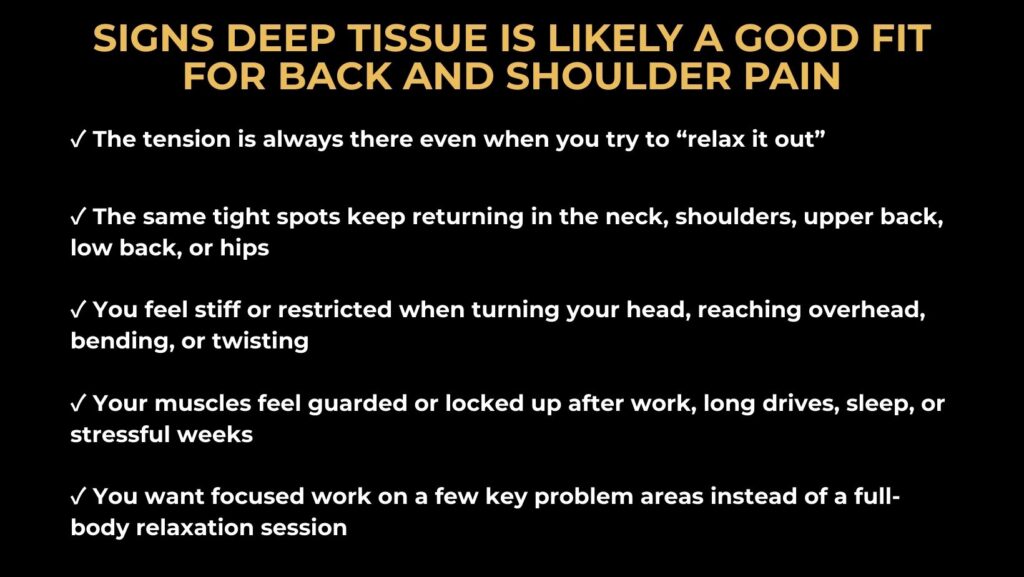
Signs Deep Tissue Is Likely a Good Fit
Deep tissue may be a good fit if your back or shoulders feel like:
- The tension is always there even when you try to “relax it out”
- The same tight spots keep returning in the neck, shoulders, upper back, low back, or hips
- You feel stiff or restricted when turning your head, reaching overhead, bending, or twisting
- Your muscles feel guarded or locked up after work, long drives, sleep, or stressful weeks
- You want focused work on a few key problem areas instead of a full-body relaxation session
If those descriptions sound familiar, deep tissue massage is often a practical option because it targets the deeper support muscles that keep pulling those areas tight.
When a Different Approach Might Be Better
Deep tissue is not always the best first step, especially if your main goal is nervous system calming rather than deeper muscle release.
A lighter approach may be a better fit if:
- You are feeling run down, overstimulated, or highly sensitive to pressure
- Your discomfort feels more like general soreness or stress-related tension, not deep muscle tightness.
- You want a session that focuses more on full-body relaxation and settling the body
In many cases, people start with a relaxation-focused massage and move into deeper work once their body responds well. Others alternate between relaxation massage, deep tissue, or other massage styles depending on how they are feeling week to week. Your RMT can adjust pressure and pacing within a session or help you decide which approach makes the most sense for your body that day.
If you would like a more detailed comparison, our Relaxation vs Deep Tissue Massage Comparison explains how each approach supports the body differently.
For a broader overview of available options, our Massage Types Explained guide breaks down different massage styles and who they tend to benefit most.
A Quick Safety Note
If you experience pain that is new, unfamiliar, or connected to a recent injury, it may be helpful to check in with your doctor or physiotherapist before booking deeper work. Massage can play a supportive role, but it works best when any underlying concerns have already been assessed.
What a Back and Shoulder Focused Deep Tissue Session Looks Like
If back or shoulder pain is your main concern, a deep tissue session is structured to focus on those areas while still supporting the rest of your body. The goal is not just to work harder, but to work more intentionally on the muscles that are contributing most to your discomfort.
In a deep tissue session focused on back and shoulders, you can typically expect:
- More time spent on the back, shoulders, and neck, with lighter or supportive work elsewhere as needed
- A gradual warm-up to prepare the muscles, followed by slow, targeted work in a few key problem areas
- Clear communication throughout the session, with your RMT checking in regularly to make sure the pressure feels productive and comfortable
There is an important difference between pressure that feels helpful and pressure that feels like too much. Your therapist will adjust pacing and depth based on your feedback so the work stays within your comfort level.
After a deeper session, mild next-day soreness can be normal, similar to how muscles feel after physical activity. If anything feels uncomfortable or unexpected, it is always okay to speak up so your care can be adjusted.
How Many Sessions Do You Need for Back and Shoulder Pain?
The number of deep tissue sessions you need for back or shoulder pain depends on how long the tension has been present and how your body responds to treatment. Some people feel noticeable relief after one session, while others benefit more from a short series or ongoing care.
1 Session for Short-Term Relief or First-Time Deep Tissue
A single deep tissue session is often helpful if you are looking for temporary relief, want to see how deep tissue feels, or need support during a particularly tight or stressful period. This option works well when tension is mild, situational, or tied to recent activity.
3 to 4 Sessions for Recurring Back or Shoulder Tension
If your back or shoulder pain keeps returning or feels deeply ingrained, booking three to four sessions over a few weeks often leads to better results. This gives the muscles time to respond between visits and helps reduce long-standing tension patterns more effectively than a one-off session.
Ongoing Sessions to Keep Tension From Building Back Up
For people who sit for long hours, lift regularly, or live with ongoing back and shoulder strain, regular maintenance sessions every three to four weeks can help keep tension from building back up. This approach focuses on staying ahead of discomfort rather than reacting once pain returns.
Simple Ways to Support Your Back & Shoulders Between Sessions
Supporting your back and shoulders between deep tissue sessions does not require a complicated routine. A few simple habits can help muscles relax more fully, reduce how quickly tension returns, and make the benefits of your massage last longer.
Helpful options include:
- Taking short movement breaks during the day, especially if you sit, drive, or stand in one position for long periods
- Doing gentle stretching in the evening or before bed to help muscles unwind after a full day
- Adjusting sitting and phone posture when you notice your shoulders creeping upward or your neck leaning forward
- Using a heat pack on the shoulders or low back after long or physically demanding days to encourage relaxation
These are not requirements or homework. Even one or two small changes can support your massage work and help your back and shoulders feel more comfortable between sessions.
FAQs: Deep Tissue Massage for Back and Shoulder Pain
Will one deep tissue massage fix my back or shoulder pain?
One session can bring relief, especially if the tension is mild or more recent. Long-standing or recurring back and shoulder tightness usually responds better to a short series of treatments, as deep tissue massage works more effectively over time.
Is deep tissue safe if I’ve had a previous back or shoulder injury?
In many cases, yes, as long as the injury has already been assessed and cleared by your doctor. Your RMT will adjust pressure and techniques to stay within comfortable and appropriate limits for your body.
What if my job keeps making my back and shoulders tight? Is there still a point?
Yes. While massage cannot remove physical job demands, regular deep tissue massage can help manage built-up tension, improve mobility, and reduce how quickly tightness returns.
Is deep tissue better than relaxation massage for back and shoulder pain?
It depends on your goals. Deep tissue targets the muscle tension driving the back and shoulder tightness, while relaxation massage calms the nervous system and eases overall tension. If back and shoulder tension is the main issue, deep tissue is usually the better starting point.
Can deep tissue massage help with tension headaches related to neck and shoulder tightness?
Many people notice improvement when neck and shoulder tension is addressed. While results vary, releasing tight muscles in these areas can help reduce the strain that contributes to tension headaches.
A Final Word on Back & Shoulder Pain
If you wake up with a tight back, carry ongoing tension in your shoulders, or feel like certain areas never fully relax, you’re not alone. These patterns often build gradually through posture, stress, physical work, and daily demands, and they rarely resolve on their own without focused care.
Deep tissue massage is designed for this type of persistent tension. By working into the areas that keep holding tight, it supports better movement, reduced stiffness, and more comfortable days between sessions.
Book a Deep Tissue Massage for Back & Shoulder Pain in Sherwood Park
At Gold Pro Massage in Sherwood Park, deep tissue sessions are personalized to your body, your comfort level, and how your back and shoulders respond to treatment. Your RMT will focus on the areas that matter most to you and adjust pressure and pacing throughout the session.
If you would like to learn more before booking, explore our Deep Tissue Massage Service page or read what deep tissue massage is for a broader look at how it works.
Note: This article is for educational purposes and not intended as medical advice. Massage therapy can help with many day-to-day concerns, but if you’re managing a health condition or pregnancy, please speak with your doctor first and let your therapist know so your session can be adapted safely.