Reviewed by Registered Massage Therapist Nuchanart (Mew) Kachowski
Updated: July 2026
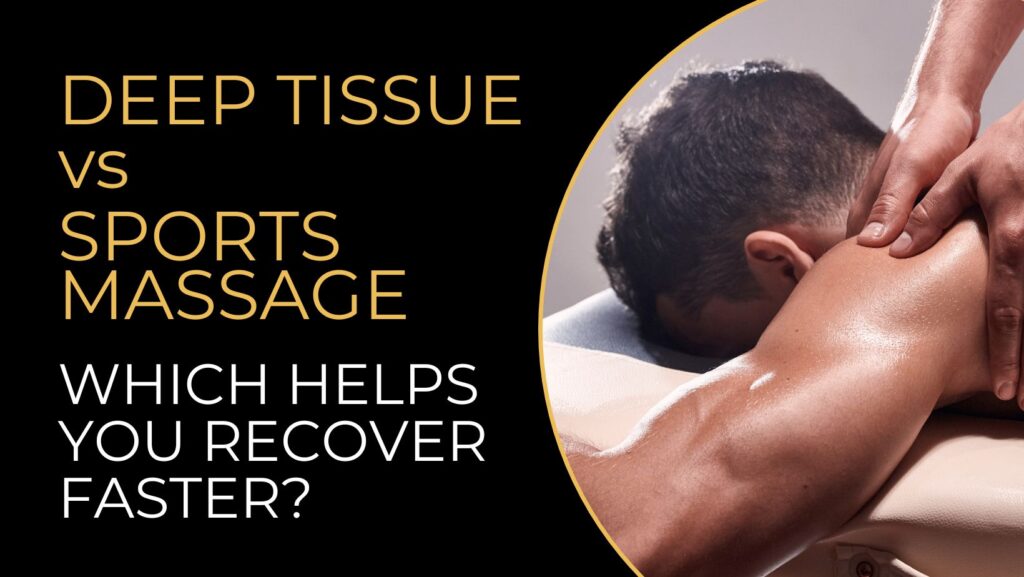
Deep tissue massage and sports massage both support recovery, but they help your body recover in different ways depending on your training, pain level, and timing.
If you’re lifting, running, training, or doing physically demanding work, it’s common to feel sore, tight, or slower to bounce back than you used to.
While both massage styles can help, choosing the wrong one at the wrong time can leave you feeling more sore instead of relieved.
This guide explains how deep tissue and sports massage work, when each one makes sense, and how to choose the right option for your recovery goals when you’re training hard, staying active, or managing ongoing aches.
Quick Answer: Deep Tissue vs Sports Massage
Choose deep tissue massage when you’re dealing with long-term tension or recurring pain.
Choose sports massage when your main goal is to recover between workouts or training sessions.
When Each Massage Makes Sense
Deep Tissue Massage
Deep tissue massage is best when tension or pain has become ongoing rather than tied to a single workout. It’s often chosen when tight areas limit movement, linger between sessions, or keep returning despite rest.
Sports Massage
Sports massage is better suited to recovery around training, practices, and events. It helps manage soreness and fatigue while keeping muscles loose and responsive so you can continue training without needing extended downtime.
Key Differences for Recovery
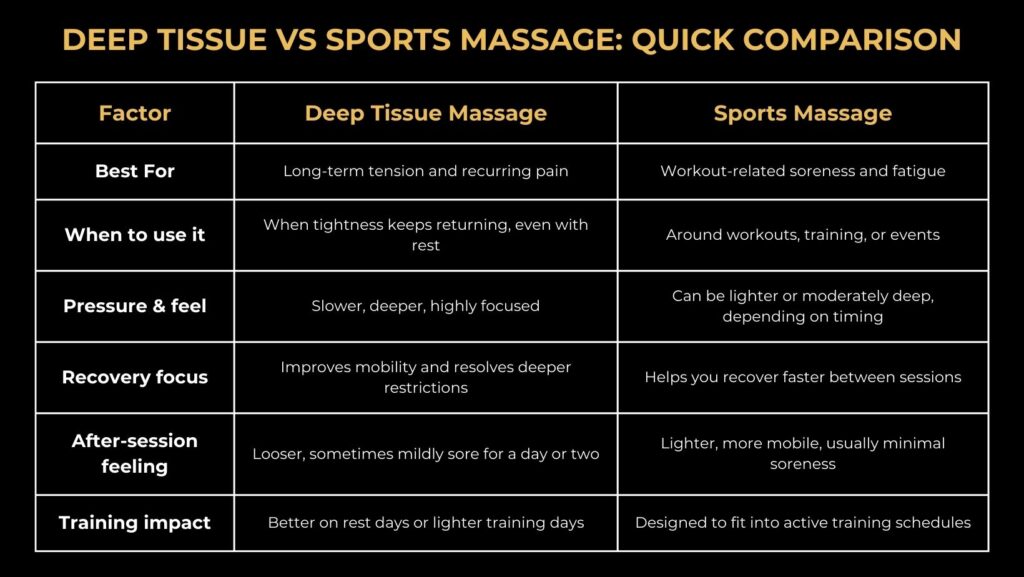
When you’d use it
Deep tissue massage makes sense when tightness or pain keeps coming back, even with rest.
Sports massage is better during training cycles or around intense workouts and events.
How it feels
Deep tissue massage uses slower, deeper pressure focused on specific problem areas.
Sports massage can feel lighter and more energizing or moderately deep, depending on timing.
Best for recovery when your goal is
Deep tissue massage helps improve mobility and resolve long-standing tension.
Sports massage helps reduce soreness and keep you ready for the next workout.
How it supports recovery
Deep tissue massage creates longer-term change in tight or restricted tissue.
Sports massage supports faster recovery between training sessions.
In simple terms, deep tissue helps when something feels stuck, while sports massage helps when your body feels worked hard and fatigued.
What Is Deep Tissue Massage?
Deep tissue massage focuses on deeper muscle layers and connective tissue to help address ongoing tightness and restricted movement that can slow recovery.
How Deep Tissue Massage Works
Deep tissue massage uses slow, firm pressure to work into deeper muscle layers and fascia. Rather than full-body relaxation, sessions focus on specific problem areas that feel tight, restricted, or repeatedly sore.
It’s commonly chosen when something feels stuck, not just tired. For a deeper explanation, see our guide to what deep tissue massage is.
What Is Sports Massage?
Sports massage is designed to support people who move regularly by helping muscles recover, stay flexible, and respond better during training.
How Sports Massage Works
Sports massage is tailored to people who exercise, train, or compete regularly. It uses a mix of techniques, including deeper pressure, trigger point work, stretching, and movement, depending on where you are in your training cycle.
Sessions may feel lighter and more energizing before an event, and slower or more focused after intense training.
How Deep Tissue and Sports Massage Affect Recovery
Both massage styles support recovery, but the way they help your body bounce back depends on whether soreness is short-term or tied to deeper, ongoing restrictions.
Muscle Soreness and DOMS (Delayed Onset Muscle Soreness)
Deep Tissue Massage
More helpful when soreness has settled into ongoing tightness or pain.
Often chosen when the same hip, back, or shoulder keeps flaring up week after week.
Sports Massage
Often more helpful within 24 to 72 hours after a hard workout or event.
Designed to reduce stiffness and help you feel more mobile sooner.
Flexibility and Range of Motion
Deep Tissue Massage
Improves range of motion gradually by freeing deeper restrictions that limit movement.
Sports Massage
Helps maintain flexibility between workouts by combining hands-on work with movement and stretching.
Injury History and Old Problem Areas
Deep Tissue Massage
Helpful when old injuries, scar tissue, or chronic problem areas resurface with activity.
Sports Massage
Useful for managing recurring “hot spots” during training without overloading already stressed tissues.
When Deep Tissue Is the Better Choice for Recovery
Deep tissue massage is usually the better option when recovery issues are tied to long-standing tension, movement restriction, or recurring pain rather than short-term soreness.
Signs You’ll Do Better With Deep Tissue
- You’ve had the same pain or tightness for weeks or months
- You feel restricted or “stuck,” even on rest days
- You’ve been cleared after an injury or surgery and want to improve mobility
Best Timing for Deep Tissue
- As a monthly or bi-weekly reset if you train hard year-round
- On rest days or lighter training days
- During off-season or lower-intensity phases
When Sports Massage Is the Better Choice for Recovery
Sports massage is often the better option when your goal is to recover between workouts while continuing to train, compete, or stay active.
Signs You’ll Do Better With Sports Massage
- You’re training consistently or preparing for an event
- Your main issue is soreness and fatigue, not chronic pain
- You want to stay loose without pausing or scaling back training
Best Timing for Sports Massage
- Before an event (1 to 2 days out) when you want lighter, activating work
- After an event (within 24 to 72 hours) when your body needs focused recovery
- During training blocks when regular sessions help maintain mobility
For more detail on timing, see When to Get a Sports Massage.
How They Feel During and After Your Session
While both massage styles can support recovery, they feel noticeably different during the session and in the day or two that follow.
What Deep Tissue Massage Feels Like
Deep tissue massage uses slower, heavier pressure focused on specific problem areas. The sensation can feel intense at times and is often described as “good pain,” especially when working through stubborn tension. Many people feel looser afterward, with mild soreness that can last a day or two, similar to how muscles feel after a solid workout.
What Sports Massage Feels Like
Sports massage can feel energizing or calming, depending on timing and focus. Sessions often include movement and stretching, especially during active training periods. Many people feel lighter and more mobile afterward, with little to no post-session soreness.
Can You Combine Deep Tissue and Sports Massage?
Yes. Many people benefit from using both deep tissue and sports massage together as part of a longer-term recovery plan, especially if they train regularly or have recurring problem areas.
Using Both in a Recovery Plan
Athletes or heavy lifters
People who train hard or lift consistently often use sports massage more frequently to manage soreness and stay mobile, while adding deep tissue periodically for deeper problem areas. A common approach is sports massage weekly or bi-weekly, with deep tissue every 3 to 4 weeks as needed.
Active but not competitive
If you stay active but are not training for events, deep tissue massage every 4 to 6 weeks can help address lingering tightness. Sports massage can be added during busier or more demanding training periods to help manage short-term soreness and fatigue.
What This Looks Like at Gold Pro
In practice, sessions are rarely locked into one strict style. Your therapist may start with sports-style techniques to warm the tissue, then add deeper, more targeted work where your body needs it most. Pressure and focus are always adjusted based on your comfort level, recovery needs, and training goals.
How to Choose the Right Massage for Your Recovery
If you’re unsure which option makes the most sense, a few simple questions can help clarify what your body needs right now:
- Is your main issue short-term soreness, or ongoing pain that keeps returning?
- Do you need to train or stay active tomorrow, or can you handle some soreness in exchange for deeper work?
- Are you maintaining how your body feels, or trying to reset lingering tension?
How Your Therapist Can Help
At Gold Pro, you don’t need to have it all figured out ahead of time. Your therapist can recommend deep tissue, sports massage, or a blend after learning more about your body, training routine, and recovery goals.
Book a Deep Tissue or Sports Massage in Sherwood Park
Not sure which fits your recovery goals? Our guide to what deep tissue massage is covers the broader basics of deep tissue if you want to think it through first.
Deep tissue massage is best for long-term tension and stubborn pain that doesn’t fully resolve on its own.
Sports massage is best around workouts and training to help you stay mobile and recover between sessions.
Many people benefit from using both as part of an ongoing recovery approach.
You can view our full list of massage services to see all available options, or book directly and let your therapist know how you’re training so the session can be guided in the right direction.
Note: This article is for educational purposes and not intended as medical advice. Massage therapy can help with many day-to-day concerns, but if you’re managing a health condition or pregnancy, please speak with your doctor first and let your therapist know so your session can be adapted safely.